
This is about as close to foolproof as bread baking gets. No kneading, no fancy equipment, no steam pans or water spritzing just a sticky dough that rises twice and bakes in buttered bowls until golden and crisp on the outside, soft and tender inside. Start it in the afternoon and you can have warm, homemade bread on the table by dinner.
Why I Love This Recipe
If I had to pick just one bread recipe to make for the rest of my life, this would be it. It’s the kind of bread that makes people ask, “Wait, you actually made this?” — and the best part is how little effort it takes to get there. There’s no kneading, no proofing gymnastics, and no special baking vessel beyond a couple of oven-safe bowls. It’s humble, “peasant” bread in the best sense: simple, spongy, moist, and endlessly good with butter.
Ingredients
- 4 cups (512g) unbleached all-purpose or bread flour
- 2 tsp (10g) kosher salt
- 2 cups (454g) lukewarm water (mix 1½ cups cold water with ½ cup boiling water)
- 2 tsp (8g) sugar
- 2 tsp (8g) instant yeast
- About 2 tbsp room-temperature butter, for greasing the bowls
How to Make Peasant Bread
- Mix the dough. In a large bowl, whisk together the flour, salt, sugar, and instant yeast. Add the water and mix until the flour is fully absorbed into a sticky dough.
- First rise. Cover the bowl with a towel or plastic wrap and let it rise in a warm spot for 1–2 hours, until roughly doubled. (A quick trick: turn the oven on briefly, then off, to create a slightly warm environment — just don’t let it get hot.)
- Prep the bowls. Preheat the oven to 425°F. Butter two 1-quart (or 1.5-quart) oven-safe bowls generously.
- Divide the dough. Using two forks, punch down the dough and scrape it away from the sides of the bowl. Divide it into two equal portions, starting from the center and pulling outward, then scoop each half into a prepared bowl. This step is messy work quickly.
- Second rise. Let the dough rise again for 20–30 minutes, uncovered, near the warm oven, until it crowns the rim of the bowls.
- Bake. Bake for 15 minutes at 425°F, then reduce the heat to 375°F and bake another 15–17 minutes. Turn the loaves out onto a cooling rack — they should release easily from well-buttered bowls. If they look pale, return them to the oven (out of the bowls) for another 5 minutes.
- Cool and serve. Let cool for about 10 minutes before slicing.
Choosing Your Yeast
Instant yeast is the easiest option it can be whisked directly into the flour with no need to proof it first. If you only have active-dry yeast on hand, dissolve the sugar into the water, sprinkle the yeast on top, and let it sit for 10–15 minutes until foamy before mixing it into the flour.
Baking Vessels
This is a very wet dough, so it needs to bake in an oven-safe bowl rather than free-form. A 1-quart Pyrex bowl is the classic choice, though any similarly sized oven-safe bowl works. If you only have a slightly larger bowl (around 1.5 quarts), you can split the dough between a 1-quart and a 1.5-quart bowl the loaves just won’t match in shape.
Tips for Success
- Weigh your flour if you can. A digital kitchen scale makes this recipe far more consistent. If measuring by volume, spoon the flour into the cup and level it off rather than scooping directly.
- Don’t over-rise the second time. The second rise should only take about 20–30 minutes much longer and the shape can suffer.
- Work fast when dividing the dough. It’s very sticky and slippery; small forks or a flexible dough scraper make this easier.
- Butter the bowls well. This is what allows the loaves to release cleanly onto the cooling rack.
Variations
- Cornmeal peasant bread: Substitute 1 cup of the flour with cornmeal.
- Faux focaccia: Spread the dough into a buttered 9×13-inch (or two smaller) baking dishes instead of bowls, drizzle with olive oil, dimple with your fingers, and top with rosemary and sea salt before baking.
- Everything bagel bread: Coat the buttered bowls with everything bagel seasoning before adding the dough.
- Whole wheat version: Substitute up to 50% of the flour with whole wheat flour (texture will be denser).
- Loaf pan method: Bake ¾ of the dough in a standard loaf pan (bake at 375°F for 45 minutes) and the rest in small ramekins for mini loaves.
- Dutch oven method: Shape the dough into a ball after the first rise, let it rest 20 minutes, then bake covered in a preheated Dutch oven at 450°F for 30 minutes, followed by 15 minutes uncovered.
Troubleshooting
- Trouble with the second rise? This is often related to the shape or size of the bowl. Don’t let the second rise go more than 30 minutes.
- High altitude adjustments: Try the recipe as written first. If needed, add a little extra water (about ¼ cup per 512g flour) since the dough tends to dry out and rise quickly at altitude, or reduce the yeast slightly to 1½ teaspoons.
Storage
This bread is best the day it’s baked, but leftover loaves make excellent toast, sandwiches, or grilled cheese over the next few days. Store at room temperature wrapped in a towel or bag for 2–3 days, or freeze whole or sliced for up to 3 months thaw at room temperature or toast directly from frozen.
FAQs
Can I use active-dry yeast instead of instant? Yes dissolve the sugar in the water, sprinkle the yeast over top, and let it sit for 10–15 minutes until foamy before mixing it into the flour. Instant yeast just skips this step, since it can go straight into the dry ingredients.
Do I really need special bowls to bake this? You need some kind of oven-safe vessel, since the dough is too wet to hold its shape freestanding. Pyrex or similar glass bowls are the easiest option, but a loaf pan, ramekins, or a Dutch oven can all be used with slight adjustments to bake time.
Why didn’t my loaves rise properly the second time? This is usually caused by letting the second rise go too long, or using a bowl shape that doesn’t support the dough well. Keep the second rise to 20–30 minutes for the best results.
Can I make this with whole wheat flour? Yes — you can substitute up to half the flour with whole wheat, though the texture will be a bit denser than the all-purpose version.
Can I double the recipe? Yes this recipe scales well. Just make sure you have enough bowls or pans sized appropriately, since overly large vessels can affect how the dough rises and bakes.
Why is my dough so sticky and hard to work with? That’s normal this is meant to be a very wet, no-knead dough. Working quickly, using small forks or a flexible dough scraper, and buttering your bowls well all make it much easier to handle.
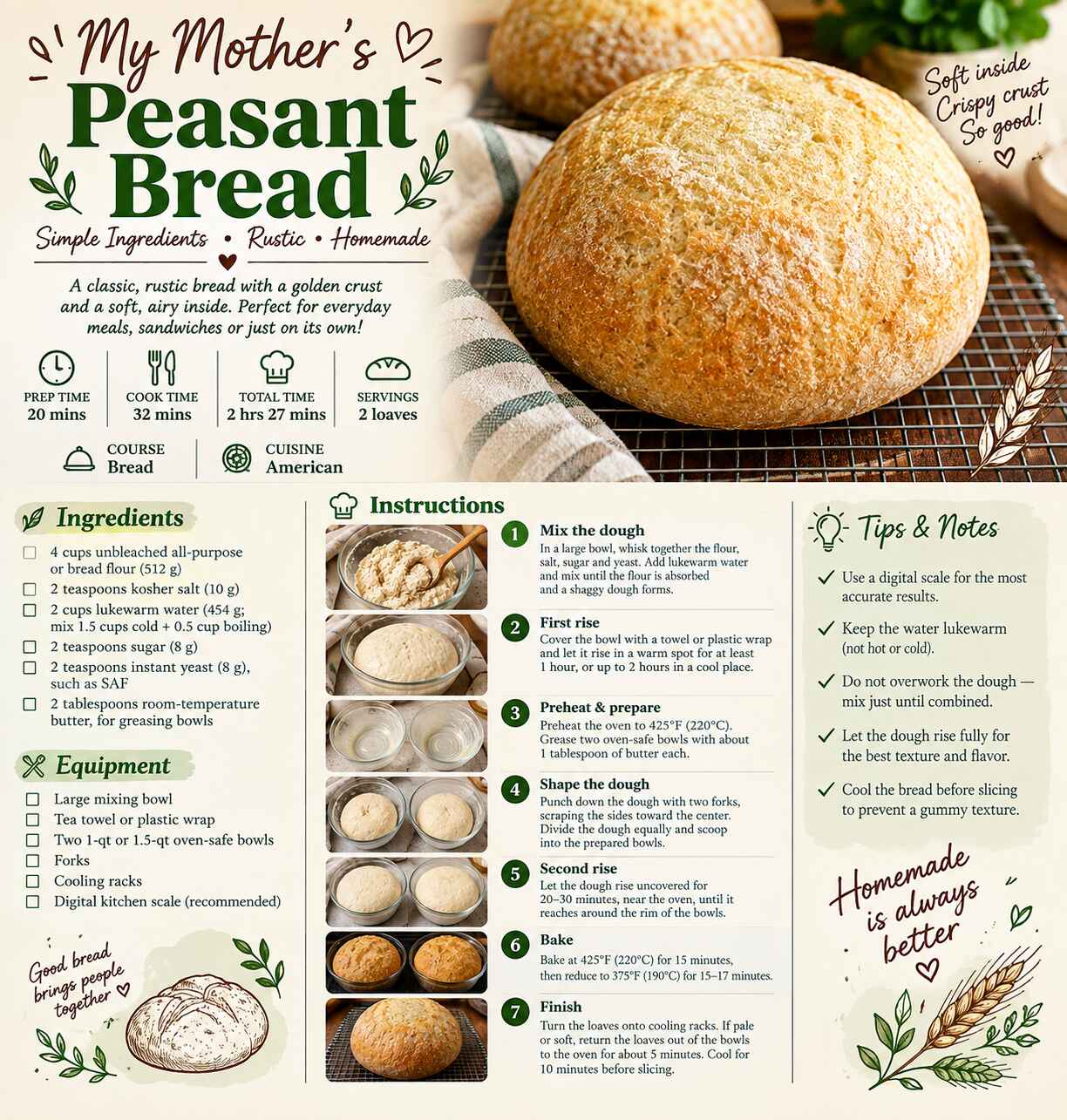

My Mother’s Peasant Bread
Ingredients
Equipment
Method
- Mixing the dough: In a large mixing bowl, whisk together flour, salt, sugar, and instant yeast. Add water and mix until flour is absorbed.
- Let it rise: Cover with a tea towel or plastic wrap and set aside in a warm spot to rise at least 1 hour (up to 2 hours in a cool place). To create a warm spot, preheat oven 1 minute then turn off.
- Preheat oven to 425°F. Grease two 1-qt or 1.5-qt oven-safe bowls with about 1 tablespoon butter each.
- Punch down dough with two forks, scraping from sides and pulling toward center. Divide dough into two equal portions and scoop into prepared bowls.
- Second rise: Let dough rise 20-30 minutes on countertop near oven (do not cover). It should rise to just below or above the rim depending on bowl size.
- Bake: Bake at 425°F for 15 minutes. Reduce heat to 375°F and bake 15-17 minutes longer.
- Turn loaves onto cooling racks. If pale/soft, return loaves (out of bowls) to oven for ~5 minutes. Cool 10 minutes before slicing.